
A long-held belief in the EDM scene is that arena shows are bad. The sound systems are built for pop stars who barely know what a MIDI controller is, and the crowd is forced into seats, isolating the DJ on their own island above the crowd. I’ve always subscribed to this belief. But when one of my “white whale” DJs, John Summit, announced that his tour would be an arena tour, I had to suck it up and see if this conviction was rooted in fact or arrogance.
Let’s start with the most obvious issue with a DJ playing to an arena: the sound. Most arenas across the US are built for sports, with the occasional pop or rock show thrown in between. The ceilings are high, the floor is concrete, and the speakers have two settings. They are either deafeningly loud or awkwardly soft. There is no nuance between a subwoofer and a tweeter. It’s one giant blob of sound that pours over the crowd like lava.
Before John Summit took the stage, Chromeo and Mesto warmed up the crowd. Those sets reinforced my fear that this would be a night of low-sound-quality sets. Both were suspiciously quiet, despite employing all the necessary drops, hi-hats, and mix-ins that make a bone-rattling sound. Conversations could be had quite easily, and unless you were at the barricade, the sound felt like background music rather than an actual opening set. I was disappointed, but again, my hopes were low, so I was ready to make the best of it.
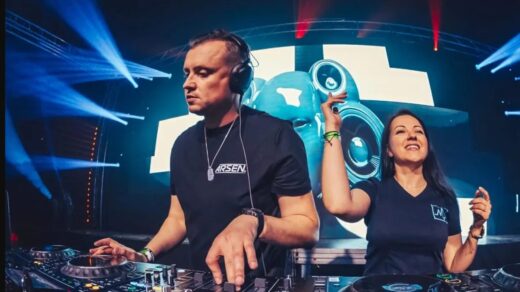
Then John Summit came on. Perhaps the low quality of Chromeo and Mesto was on purpose, anticipating that a still trickling-in crowd needed to be able to converse as they found their seats. Maybe Chromeo and Mesto didn’t have the right sound equipment to create the booming sounds necessary in that type of environment. Whatever the reason, John Summit did not meet the same fate. From the first note, his sound filled every corner of the room. It rattled my collarbone, but never blew out my eardrums. I could hear the subtlety between each interval. It wasn’t muddled or overbearing like I had expected. John and his team had somehow cracked the code to making EDM sound good in a giant concrete box.
So, that’s one myth debunked. EDM can sound good in an arena. It just needs quality sound engineers.
On to myth number two. EDM can’t be good in arenas because most of the crowd is sequestered to the stands. This holds just as much validity as the prior myth. The basis of EDM has always been connection. Unlike other genres, DJs are heavily critiqued on their connection with the crowd. Shows in the round, with fans on stage with the DJ, are the norm. An arena show provides a small GA area that can cost upwards of $400. Anyone who doesn’t want to pay absurd prices is relegated to the stands with an actual seat. In theory, this shouldn’t be a big problem, but in practice it can separate fans not only from the DJ, but also from the community around them.
My seats were in the nosebleeds, where I was closer to the ceiling catwalk than John Summit. The experience was a mixed bag. The good part was that we all had our own designated area to dance. We didn’t have to watch for flailing limbs or misplaced shuffles. But we did lose the camaraderie that can only come from locking eyes with someone as the filthiest drop of your life graces your ears. It made the show feel like just a show instead of a collective experience.
John seemed to anticipate this problem and did one of the most innovative, coolest things I’ve seen in an arena show. Before the show, he blocked a handful of seats and set up his decks right in the middle of the stands. About halfway through his set, he went to those decks and gave a pure DJ performance, brushing shoulders with his fans by bringing the music to the ground level. Even though the section he set up in was far away from mine, I could feel its energy radiating throughout the arena. Furthermore, I thought that the moment showed that John still knows his roots. Yes, he’s doing a large-scale arena tour with dancers, visuals, and a storytelling element akin to an Ariana Grande concert, but at the end of the day, he’s still a DJ. He is trying to make music that we can dance to and dance to, together.
So, myth number two is somewhat true. A level of disconnection happens when people are forced into tiny boxes and encouraged to stay in them, but if the DJ is smart, they can manufacture moments of connection.
All in all, I left the show feeling pleasantly surprised. I expected an experience with more disappointments than satisfaction. In reality, I was able to shatter some long-standing opinions and gain a wider perspective on what is possible for DJs in live shows. I’ll always take a small club show over an arena, but I’d be happy to see some more DJs take on the arena format. Who knows? Maybe a new type of live show will come from it.